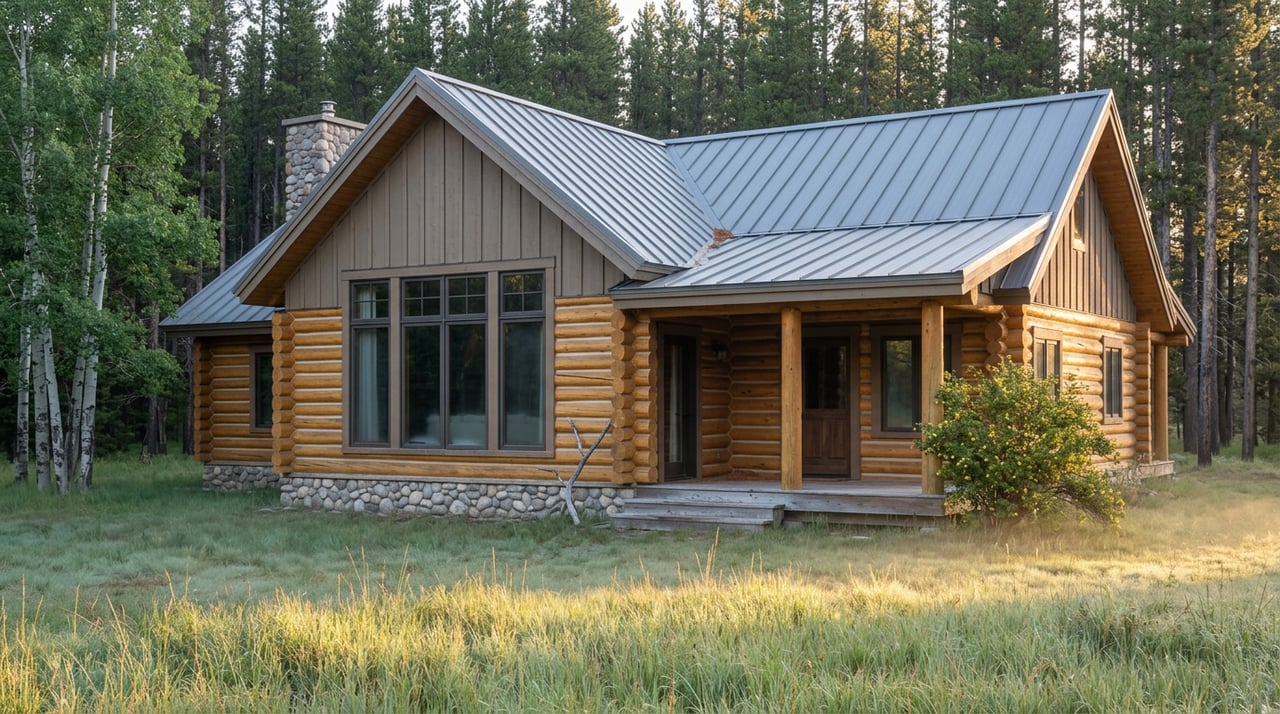
A buyer touring a log home outside Clark this spring did the math out loud on the porch: twice the acreage, comparable finishes, at roughly half of what a similar property costs inside Steamboat Springs city limits. The gap itself isn't a secret. It shows up in every broker report published this year. What's harder to find is the reason underneath it.
The honest answer isn't just distance from the gondola, though that's part of any conversation about North Routt. It's a document most buyers never think to ask for: Routt County's road maintenance classification, the quiet system that decides whether a driveway gets plowed by 8 a.m. most winter mornings or not plowed at all.
The Number Everyone Already Knows
At the end of 2025, broker-reported figures put the median single-family sale price at $2.09 million inside Steamboat Springs, compared with $949,000 in Clark, $860,500 in Oak Creek, and $580,750 in Hayden, according to figures compiled by Steamboat Pilot & Today from broker Doug Valicenti. Multi-family medians followed the same pattern: $863,000 in town against $441,500 in Oak Creek and $394,000 in Hayden.
Individual sales this year echo the same spread. A two-bedroom home in Hahns Peak, sitting next to Steamboat Lake, sold for $485,000, a price that would barely cover a down payment on many in-town properties. A home built specifically around the North Routt lifestyle closed at $925,000, still well under half of the city median.
Numbers like that get repeated in every market update, and they're accurate. What they don't explain is why a cabin fifteen minutes past Clark can cost less per square foot than a condo a mile from the base area, even when both sit on comparable lots with comparable views. The missing variable isn't the house. It's the road that reaches it.
| Area | Median single-family price, year-end 2025 |
|---|---|
| Steamboat Springs | $2.09 million |
| Clark | $949,000 |
| Oak Creek | $860,500 |
| Hayden | $580,750 |
Three Classes of Road, One Winter
Routt County splits its roads into three working categories, and the distinction matters far more in December than it does in July. Primary roads carry school buses and mail routes, are mostly paved or chip sealed, and get the county's highest priority, plowed through the winter and kept close to normal driving condition. Rural roads serve a mix of agricultural and residential parcels and get maintained enough for what the county's extension office calls adequate, sufficient travel, though plowing may not be prompt. Minimal Maintenance roads are the third category, and the name isn't a euphemism. These routes are rarely graveled, aren't snowplowed at all, and the county advises against travel when they're wet, with some segments restricted outright during spring thaw.
A buyer comparing two North Routt listings a few miles apart can be comparing two entirely different categories without ever seeing that distinction on the flyer.
One Plow, Once a Day, County-Wide
Even inside the categories the county does maintain, the operational reality is leaner than most buyers assume. Routt County's Road and Bridge Department plows and maintains roughly 160 miles of paved road and 500 miles of gravel road, and does it with a single plow shift covering every road classification, county-wide, on that same shift. The county does not maintain state highways, streets inside incorporated towns, or private roads.
County Road 129, the paved corridor that carries North Routt residents past Clark toward Steamboat Lake State Park, is the through-route the county's own road maintenance map ties to Hahns Peak, Steamboat II, and the subdivisions further up the valley. A paved, high-traffic corridor like that is a reasonable proxy for backbone infrastructure. The gravel spurs branching off it toward individual subdivisions are a different conversation entirely, and worth confirming one at a time.
The department's own safety language sums up what living on that backbone feels like in January.
"Don't crowd the plow."
It's a simple ask. Give the operator about 150 feet of space, because a windshield full of scoria isn't the only cost of following too close on a county road built to serve a wide, spread-out population with one crew per shift.
Whose Driveway Is It, Really
Even on a road the county maintains well, the driveway connecting that road to the house is the buyer's responsibility, not the county's. Routt County is explicit that it holds no obligation for constructing or maintaining private driveways. Culverts, gravel, labor, and ongoing upkeep sit with the property owner, and any new driveway connecting to a county road requires a permit and an inspection before it's approved. Some parcels even carry cattle guards with removable wings that the landowner is responsible for pulling before winter so a plow can pass, then reinstalling once the snow clears.
None of that shows up in a listing photo. It shows up the first spring a driveway washes out, or the first winter a homeowner realizes the plow stops at the mailbox and the last quarter mile is theirs alone.
Building New Doesn't Buy a New Maintenance Promise
One line from the county's own rural roads guidance is worth sitting with before getting attached to a raw parcel. Putting a house where there used to be only a haystack does not obligate the county to start maintaining the road that reaches it. The county's road maintenance plan has hardened those boundaries over time, and current policy is not to extend county maintenance further. A lot that looks buildable on a plat map can still sit outside the zone the county has committed to keeping open in winter, and that's a fact worth confirming before the parcel becomes a deposit.
What to Check Before You Write the Offer
- Ask Routt County Road and Bridge for the maintenance classification of the specific road, Primary, Rural, or Minimal Maintenance, before falling for the view.
- If the road is privately maintained, find out who holds that responsibility, an HOA, a formal road maintenance agreement, or the seller personally, and what it costs each year.
- Confirm the driveway connecting the house to any county road has an approved permit on file, not just a worn-in path that's been used for years without one.
- If private plowing or grooming happens on the road beyond county service, check that the current provider holds a snow removal permit, a requirement the county reminded residents about as recently as December 2025.
None of this is a reason to avoid North Routt. It's a reason to price the tradeoff correctly. A property on a Primary road with a documented HOA maintenance agreement is a genuinely different asset than one on a Minimal Maintenance route with an unpermitted driveway, even when the listing photos look nearly identical and the price per square foot is close.
FAQ
Does a lower price in North Routt always mean worse road access? No. Some stretches of County Road 129 and its Primary-classified feeders get the same daily plow priority as roads inside town. The price gap has more than one driver, including commute distance and utility setup, and road classification is one piece to check parcel by parcel rather than an assumption to make about the whole area.
How do I find out which classification a specific road carries? Routt County Road and Bridge maintains the county's road maintenance level map and can identify the classification for a specific segment. Confirming this before an offer takes one phone call and removes most of the guesswork.
Is a privately maintained road automatically a dealbreaker? Not at all. Several long-standing North Routt subdivisions maintain their own roads well through organized agreements among owners. The point isn't to rule out private maintenance, it's to know which model applies to a specific property and what it costs before that cost becomes a surprise.
If you're weighing a North Routt parcel against something closer to town, the Shelley Stanford Team can pull the road classification, the maintenance history, and the real cost of ownership before you write anything down. Contact us to talk through what a specific property's price is actually measuring.